Artificial Leaves have moved beyond simple decorative fillers. Buyers now expect realistic color, flexible stems, consistent leaf shapes, and dependable repeat orders. China is a major sourcing base, but “top supplier” can mean different things: strong export experience, custom production, or reliable quality control. There is no single ranking that fits every buyer.
Market data offers useful context, with important limits. Grand View Research estimated the global artificial plants market at about USD 1.7 billion in 2023 and projected continued growth through 2030. That figure covers artificial plants broadly, not leaves alone. UN Comtrade’s HS 6702 trade category includes artificial flowers, foliage, and fruit; it is therefore a useful trade proxy, not a precise measure of artificial-leaf sales. The category is imperfect. Product-level checks still matter.
This guide examines Chinese suppliers through practical criteria: material choices, sample accuracy, customization options, production capacity, packaging, and export documentation. A close-up sample can reveal details that a catalog photo hides, such as rough edges or uneven coloring. Ask suppliers how they inspect batches, and request clear specifications before comparing quotations. A low price is not the whole story. Supplier claims should be verified against samples, records, and communication. The shortlist that follows is a starting point, not a guarantee; the best match depends on your product design, order size, and quality expectations.
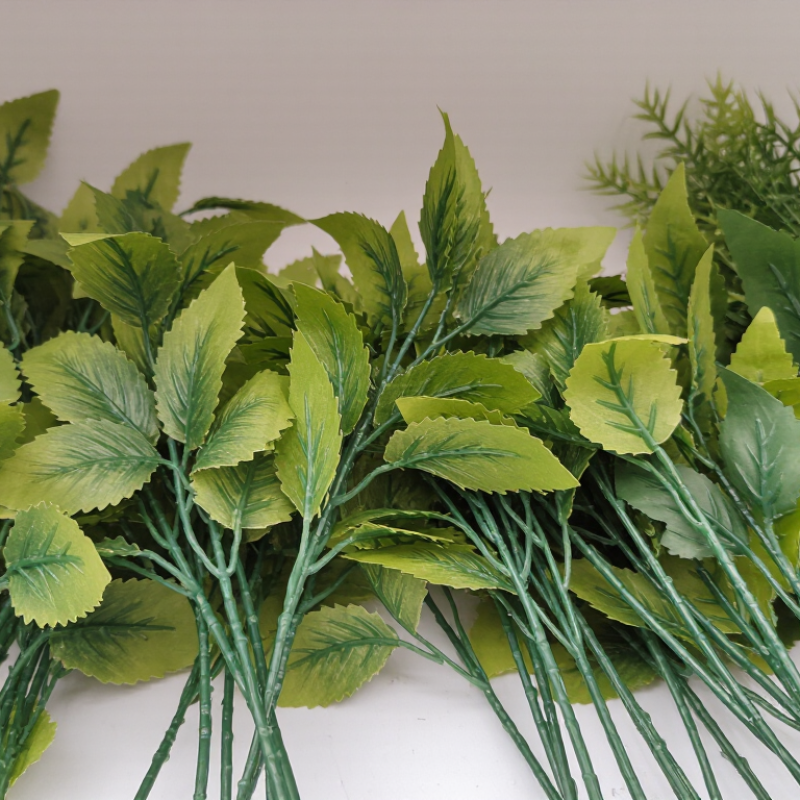
Artificial leaves are manufactured foliage designed to imitate the shape, color, and texture of living plants. They commonly use molded plastic, fabric, or coated materials, with wire-supported stems that can be bent into position. You will find them in office reception areas, shop displays, event backdrops, and homes where natural light is limited. Some are used in green walls or mixed with real greenery. They add color without watering, but they do collect dust.
The market is growing. Grand View Research’s 2024 Artificial Plants Market report estimated the global market at USD 1.67 billion in 2023 and projected a 4.5% compound annual growth rate from 2024 to 2030. That figure covers artificial plants broadly, not leaves alone. It signals wider demand, though a market forecast cannot tell buyers whether a specific leaf looks convincing. Close inspection still matters. Veins, edge finish, and color variation often reveal the difference; honestly, some products look flat under bright lighting.
Tips: Check the leaves from arm’s length and up close. Bend a sample stem gently, then see whether it holds its shape. For food-service or public interiors, verify the supplier’s relevant material and fire-safety documentation before ordering. Dust them regularly; neglected foliage looks dull fast.

China’s artificial leaf supply market is organized around several connected roles, not a single type of supplier. Material producers provide plastic films, fabrics, wire stems, and colorants. Converting factories cut, mold, print, and assemble these materials into leaves. Some focus on realistic textures; others serve large orders where consistent color and cost matter more.
Small details count. Vein depth, edge trimming, and stem flexibility can change how a leaf looks on a finished plant.
Between factories and overseas buyers, trading companies may coordinate sampling, mixed orders, packaging, and shipment schedules. Their value often lies in communication and order management, though their production control can vary. The labels can blur. A supplier may make some components in-house and source others from nearby workshops.
Buyers should ask who handles each production step, then compare samples under daylight and indoor lighting. Check color consistency across batches, leaf attachment strength, and packaging damage after transit. A showroom sample may look convincing, but repeated handling can reveal loose stems or brittle edges.
One test is never enough.
Supplier directories can help identify candidates, but they rarely show how well a factory manages quality changes during a busy production run.
China’s artificial leaf suppliers often fall into several practical profiles. Production-focused manufacturers serve wholesalers, landscaping contractors, and display makers. They typically offer repeatable leaf shapes, multiple colors, and bulk packaging. Ask how they control color across production batches. A sample may look consistent, while a larger order can reveal variation.
Design-led suppliers focus on realistic details. Vein patterns, leaf edges, stem flexibility, and surface sheen all affect the finished look. Some offer custom dimensions or foliage combinations for hotel displays and retail installations. Request close-up photographs and a physical sample. Small details matter.
Export-oriented suppliers may provide clearer specifications, packing options, and production updates. Check material descriptions, leaf dimensions, color choices, and care instructions before ordering. If the leaves will be used outdoors, ask how the supplier describes their weather resistance; do not assume indoor products will perform well outside. A polished catalog helps, but it is not proof of consistent quality. I would compare samples from several suppliers, though even that cannot predict every production issue.
Chinese artificial-leaf suppliers differ less by catalog size than by control over materials, molding, and repeatability. Some focus on low-cost PVC foliage for seasonal displays; others offer PE leaves with molded veins, fabric blends, or UV-stabilized finishes for outdoor use. Ask for close-up samples, stem-wire gauges, color tolerances, and carton-drop results. A glossy sample can hide uneven backs or brittle joints. That matters.
Grand View Research’s Artificial Plants Market report valued the global market at USD 1.41 billion in 2023. It projected 4.4% annual growth through 2030. This is a market-wide estimate, not a China supplier ranking. UN Comtrade’s HS 6702 category groups artificial flowers, foliage, and fruit, so trade totals cannot isolate leaf quality or factory capability. Compare suppliers on batch inspection records, sample-to-order consistency, mold access, minimum order quantities, and realistic lead times. For outdoor projects, request UV-aging data and inspect color shift after exposure; “UV resistant” alone proves little. I would still verify test methods, because comparable claims are not always comparable. Smaller workshops may customize quickly, but capacity evidence can be thin. Not all do. Before scaling, approve a production sample and check several cartons, not just one.
Anonymous, non-ranked comparison of common product categories and supplier capabilities. These are market-level observations, not claims about any specific supplier.
| Product category | Common product formats | Materials and construction commonly encountered | Capabilities to compare | Buyer verification points |
|---|---|---|---|---|
| Decorative artificial foliage | Individual leaves, stems, vines, and foliage garlands for interior decoration and displays. | Plastic leaves, often made from PE or PVC, attached to plastic or wire-supported stems; construction varies by design. | Range of leaf shapes and colors, molding or finishing options, assembly consistency, and custom color development. | Request material details, physical samples, color references, and confirmation that bulk production will match the approved sample. |
| Artificial green wall panels | Interlocking or attachable foliage panels for decorative walls, partitions, and event backdrops. | Plastic foliage fixed to a backing grid or mesh; panel dimensions and connection methods differ by product. | Panel-to-panel visual consistency, backing strength, connection design, and ability to produce coordinated panel sets. | Check panel measurements, attachment method, foliage coverage, finished-wall appearance, and packing protection against crushing. |
| Outdoor-oriented artificial leaves | Foliage panels, screens, and decorative leaf products marketed for outdoor use. | Plastic components may include UV-stabilizing additives, but outdoor performance depends on the specific formulation and exposure conditions. | Evidence of testing for the intended exposure, weather-related product specifications, and clear limits on recommended use. | Ask for test reports tied to the offered product and clarify test method, duration, and conditions. Do not treat “UV-resistant” as a universal performance rating. |
| Custom or project-specific foliage | Custom colors, shapes, panel layouts, stem lengths, or combinations developed for a particular order. | May use existing components, modified tooling, or newly developed parts; the approach depends on the requested design. | Sample development, design communication, tooling coordination, production repeatability, and the ability to document approved specifications. | Agree in writing on drawings, color references, tolerances, sample approval, tooling ownership, and change-control arrangements. |
| Quality, compliance, and export readiness | Relevant to all product categories and destination markets. | Requirements depend on the product, materials, intended use, and importing market; there is no single test that covers every artificial-leaf product. | Documented inspections, traceable specifications, market-specific testing where required, and export packaging suitable for the shipment. | Verify certificates and reports with the issuing body where appropriate, confirm they cover the exact product, and assess samples before placing a production order. |
Supplier capabilities, minimum order quantities, pricing, and lead times vary by product and order specification. Compare current quotations and product-specific evidence rather than relying on a general supplier ranking.
Choosing an artificial leaf supplier takes more than comparing quoted prices. Grand View Research estimated the global artificial plants market at USD 1.7 billion in 2023, with projected growth of 4.8% annually through 2030. That demand makes production consistency worth checking. Ask for samples from different production batches, not just a polished showroom piece. Look closely at leaf edges, stem wires, color variation, and coating odor.
Request written specifications for leaf dimensions, material composition, and color tolerance. Ask how the factory checks UV resistance and colorfastness, and request test records where available. A sample may look convincing under warm showroom lights. Check it beside a window, too. Small differences matter across a large installation. I would not rely on photos alone; they hide brittle stems and uneven finishes.
Review the supplier’s inspection process, monthly capacity, lead times, and packaging method. Request a recent inspection report and a carton sample, then check whether leaves arrive crushed or detached. Compare defect-handling terms before placing a large order. An unusually low quote can reflect thinner leaves or inconsistent coloring, but price alone proves little. Some details remain hard to judge until production starts, so a small paid trial order can reveal gaps before they become costly.
Use these indicative weights to compare suppliers: assess sample quality and material consistency first, then customization, production capacity, compliance documentation, total cost, and after-sales support. The percentages are a suggested evaluation framework, not market statistics or a ranking of specific companies.